
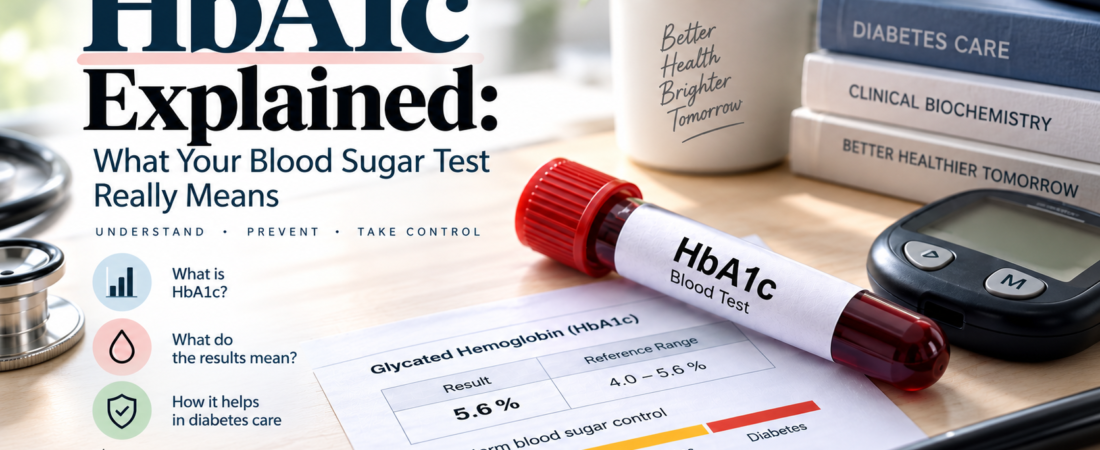
If you have had a blood test recently, you may have noticed a result called HbA1c. It is also known as glycated hemoglobin. Unlike a blood sugar test that tells you your glucose level at one particular time, HbA1c gives an idea of your average blood sugar over the past two to three months.
HbA1c is commonly used to check for prediabetes and type 2 diabetes and to monitor blood sugar control in people who already have diabetes. But what do the numbers mean? Do you need to fast before the test? Can anemia affect the result? Let’s understand it simply.
What is HbA1c?
HbA1c is a blood test that shows how much glucose has been attached to hemoglobin in your red blood cells.
Hemoglobin is a protein inside red blood cells that carries oxygen around the body. When glucose is present in your blood, some of it naturally attaches to hemoglobin. This is called glycation.
If your blood sugar stays high over time, more glucose attaches to hemoglobin. The HbA1c test measures this as a percentage.
Because red blood cells usually live for about three months, HbA1c gives a longer-term picture of your blood sugar rather than just showing what your sugar was on the day of the test.
What do HbA1c numbers mean?
For most non-pregnant adults, the commonly used HbA1c categories are:
- Below 5.7% — generally considered normal
- 7% to 6.4% — prediabetes range
- 5% or higher — diabetes range
These are diagnostic thresholds used in the American Diabetes Association’s 2026 Standards of Care.
An important point: one HbA1c result in the diabetes range does not always mean that diabetes should immediately be diagnosed. If a person does not have clear symptoms of high blood sugar, the abnormal result usually needs confirmation with another test or a repeat test.
What does prediabetes mean?
An HbA1c between 5.7% and 6.4% is called the prediabetes range.
Prediabetes does not mean that you definitely have diabetes. It means your blood sugar is higher than normal and your risk of developing type 2 diabetes is increased.
The higher the HbA1c within this range, the greater the risk generally becomes. Finding prediabetes gives you an opportunity to take steps that may reduce your risk of progressing to diabetes.
Do you need to fast for an HbA1c test?
No. You normally do not need to fast for an HbA1c test.
The sample can generally be taken at any time of the day. However, if your doctor has ordered other tests that require fasting, such as a fasting blood glucose or certain lipid tests, you may still be asked not to eat or drink for a specified period.
HbA1c vs fasting blood sugar: What is the difference?
These tests answer different questions.
Fasting blood sugar measures your glucose at one particular time, usually after at least eight hours without food.
HbA1c gives a picture of your average blood sugar over the previous two to three months.
Because they measure different things, the results do not always match. For example, someone may have a normal fasting sugar on a particular morning but still have a higher HbA1c because their blood sugar has been elevated at other times.
Your doctor may use more than one test when checking for diabetes.
How is diabetes diagnosed?
For non-pregnant adults, diabetes may be diagnosed using one of several accepted tests:
- HbA1c of 6.5% or higher
- Fasting plasma glucose of 126 mg/dL or higher
- 2-hour plasma glucose of 200 mg/dL or higher during a 75-g oral glucose tolerance test
- Random plasma glucose of 200 mg/dL or higher when typical symptoms of high blood sugar are present, or during a hyperglycemic crisis
When there is no clear evidence of high blood sugar, an abnormal result generally needs confirmation before a diagnosis is made.
Can HbA1c be inaccurate?
HbA1c is a very useful test, but it is not perfect for everyone.
The result can be affected by conditions that change the number, lifespan or characteristics of red blood cells or hemoglobin. Examples include:
- Some types of anemia
- Iron deficiency
- Certain hemoglobin variants
- Sickle cell disease
- Thalassemia and other hemoglobin disorders
- Recent significant blood loss
- Recent blood transfusion
- Increased destruction of red blood cells (hemolysis)
- Some kidney or liver conditions
- Certain treatments that affect red blood cell production
If your HbA1c result does not seem to match your blood sugar readings or symptoms, your doctor may recommend another test or look for a condition that could be affecting the result.
Why can this matter for Indian patients?
Anemia and iron deficiency are common health problems in India, and research has shown that they can sometimes affect how HbA1c should be interpreted.
Hemoglobin disorders and other factors can also influence HbA1c measurements. A 2026 review focusing on Indian populations highlighted anemia, hemoglobin disorders, G6PD deficiency and laboratory testing methods as possible limitations when HbA1c is used on its own.
This does not mean that HbA1c is unreliable in Indian patients. It means that the result should be considered together with your symptoms, medical history and other test results, especially when the numbers do not agree.
Can iron-deficiency anemia affect HbA1c?
Yes. Iron deficiency and some forms of anemia can affect HbA1c levels.
This does not mean that every person with anemia will have an incorrect HbA1c result. The important point is that a doctor may need to interpret the result alongside other blood tests and glucose measurements.
If your HbA1c suggests prediabetes or diabetes but your other glucose results do not agree, further testing may be appropriate.
How often should HbA1c be checked?
The timing depends on your health and whether you have diabetes or prediabetes.
People with diabetes may have HbA1c checked at least twice a year when their blood sugar is at their treatment goal. Testing may be needed more often when treatment has changed or blood sugar is not well controlled.
For people with prediabetes, the ADA 2026 Standards recommend checking for progression to diabetes at least yearly.
People without diabetes or prediabetes generally do not need frequent HbA1c testing. Your doctor can suggest an appropriate interval based on your age, risk factors and previous results.
Can HbA1c show recent changes in blood sugar?
Not exactly. HbA1c is designed to show longer-term blood sugar exposure, not day-to-day changes.
A major change in blood sugar during the last few weeks can affect the HbA1c result, and recent glucose levels have a greater influence than levels from several months ago. However, a glucose meter or continuous glucose monitor is better for seeing short-term changes and daily fluctuations.
What is a good HbA1c level for someone with diabetes?
There is no single HbA1c target that is right for every person with diabetes.
For many non-pregnant adults, a target below 7% is commonly used. However, the goal may be different depending on factors such as age, how long the person has had diabetes, risk of low blood sugar, other medical conditions, diabetes complications and overall health.
Do not change your diabetes medicines just because your HbA1c is higher or lower than a particular number. Discuss the result with your healthcare professional.
Can you lower your HbA1c?
If your HbA1c is high because of elevated blood sugar, improving overall glucose control can help lower it.
Depending on your situation, this may include:
- Eating a balanced diet suited to your health needs
- Being physically active regularly
- Maintaining a healthy body weight when appropriate
- Taking prescribed medicines as advised
- Checking blood sugar when your doctor recommends it
- Getting adequate sleep
- Avoiding tobacco
- Attending regular medical check-ups
For people with prediabetes, healthy lifestyle changes can reduce the risk of progressing to type 2 diabetes.
There is no single home remedy or one “best diet” that works for everyone. Diabetes and prediabetes management should be individualized.
When should you talk to a doctor about your HbA1c?
Speak with a healthcare professional if:
- Your HbA1c is 6.5% or higher
- Your HbA1c is between 5.7% and 6.4%
- Your HbA1c does not match your blood sugar readings
- You have increased thirst or frequent urination
- You have unexplained weight loss
- You have significant anemia or iron deficiency
- You have a known hemoglobin disorder
- You are pregnant
- Your HbA1c changes unexpectedly
- You already take diabetes medicine and your result has changed significantly
Your HbA1c should be interpreted together with your symptoms, medical history and other investigations.
Frequently Asked Questions
Is HbA1c the same as blood sugar?
No. HbA1c reflects longer-term blood sugar exposure, while a blood glucose test measures your sugar at a particular point in time.
Is an HbA1c of 5.7% diabetes?
No. An HbA1c of 5.7% is at the beginning of the prediabetes range.
Is an HbA1c of 6.5% diabetes?
6.5% or higher is in the diabetes diagnostic range. If there are no clear symptoms of high blood sugar, confirmation with another abnormal test is generally needed.
Do I need to fast before an HbA1c test?
No. Fasting is not normally required for the HbA1c test itself.
Can anemia affect HbA1c?
Yes. Some types of anemia and iron deficiency can affect HbA1c interpretation. Hemoglobin disorders and conditions that change red blood cell lifespan can also affect the result.
Can fasting sugar be normal while HbA1c is high?
Yes. The two tests measure different aspects of blood sugar, so they can sometimes give different results.
Is HbA1c used to diagnose diabetes during pregnancy?
HbA1c is not the standard test for diagnosing gestational diabetes. Pregnancy has specific testing recommendations, commonly including an oral glucose tolerance test at the recommended stage of pregnancy.
Key Takeaways
- HbA1c gives an estimate of your average blood sugar over the previous two to three months.
- Below 5.7% is generally considered normal; 5.7%–6.4% is the prediabetes range; 6.5% or higher is the diabetes diagnostic range.
- You normally do not need to fast for an HbA1c test.
- HbA1c and fasting blood sugar provide different information.
- Anemia, iron deficiency and some hemoglobin disorders can affect HbA1c interpretation.
- A diabetes diagnosis may need confirmation when there is no clear evidence of high blood sugar.
- Your personal HbA1c target should be decided with your healthcare professional.
Medical Disclaimer
This article is for general health education and is not a substitute for medical advice, diagnosis or treatment. A laboratory result should always be interpreted in the context of your symptoms, medical history and other investigations. If you are concerned about your HbA1c or blood sugar, consult a qualified healthcare professional.
References
- American Diabetes Association Professional Practice Committee. 2. Diagnosis and Classification of Diabetes: Standards of Care in Diabetes—2026. Diabetes Care. 2026.
- National Institute of Diabetes and Digestive and Kidney Diseases (NIDDK). The A1C Test & Diabetes. National Institutes of Health.
- National Institute of Diabetes and Digestive and Kidney Diseases (NIDDK). Diabetes Tests & Diagnosis. National Institutes of Health.
- American Diabetes Association Professional Practice Committee. 3. Prevention or Delay of Diabetes and Associated Comorbidities: Standards of Care in Diabetes—2026. Diabetes Care. 2026.
- Samajdar SS, et al. The limitations and fallacies of relying on glycosylated hemoglobin for diagnosing and monitoring diabetes in Indian populations. Lancet Regional Health – Southeast Asia. 2026.
- Madhu SV, et al. Effect of iron deficiency anemia and iron supplementation on HbA1c levels – implications for diagnosis of prediabetes and diabetes mellitus in Asian Indians. Clinical Chimica Acta. 2017.
- Attard SM, et al. Implications of iron deficiency/anemia on the classification of diabetes using HbA1c. Nutrition & Diabetes. 2015.
- Unnikrishnan R, Mohan V. Challenges in estimation of glycated hemoglobin in India. Diabetes Technology & Therapeutics. 2013.